
How Target Reflectivity Affects Laser Rangefinder Distance
When a laser rangefinder reaches 10 km on one target but only 6 km on another, many people first suspect the laser power or receiver sensitivity.
Quite often, the target itself is the reason.
A laser rangefinder does not measure distance simply because a laser pulse reaches an object. The receiver must get enough of that pulse back to recognize it. A large concrete wall, a dark vehicle, a glass surface, and a patch of vegetation can all sit at the same distance yet produce very different return signals.
That is why a distance such as “8 km” or “20 km” should never be read without looking at the target conditions behind it.
For engineers selecting a laser ranging module, target reflectivity is one of the first things worth checking.
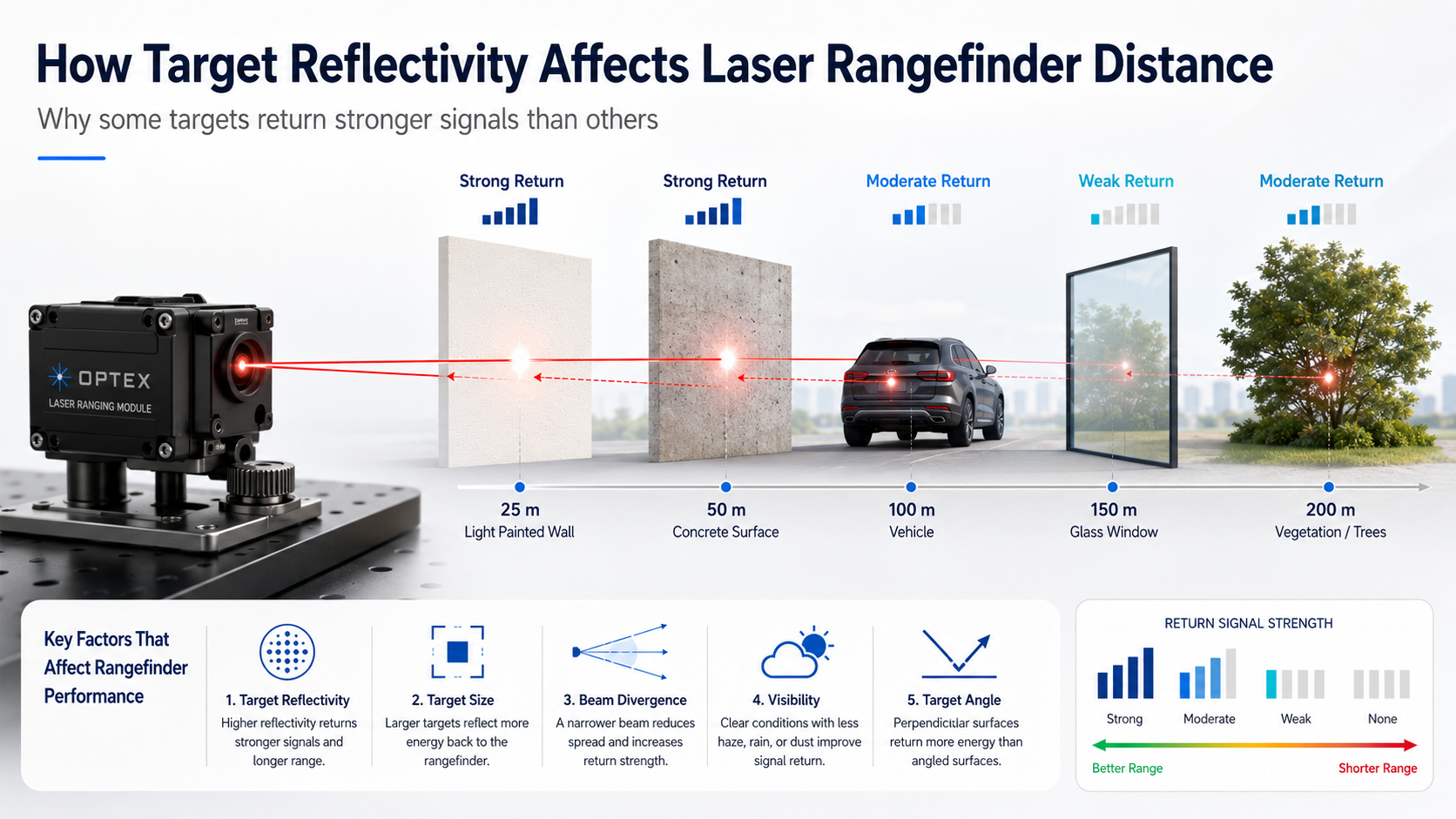
Laser Rangefinder Target Reflectivity: Why Does It Matter?
Whatever it is, the way you tell your story online can make all the differencLaser rangefinder target reflectivity describes how much useful laser energy a target sends back after it is illuminated.
A target may reflect a large amount of optical energy, but if most of that light travels away from the receiver, the rangefinder still sees a weak return.
A rough painted wall tends to scatter light in many directions. Some of that scattered light usually travels back toward the receiving optics.
A polished metal plate behaves differently. It may reflect strongly, yet send most of the energy in one preferred direction. Unless the geometry is favorable, the rangefinder may receive less energy than expected.
The receiver only works with what comes back into its aperture.
That makes reflectivity closely tied to surface texture, angle, wavelength, and target size.
What Laser Rangefinder Target Reflectivity Really Means
From the rangefinder's point of view, the process is simple:
The transmitter sends a short laser pulse.
The pulse travels through the atmosphere.
Part of the beam reaches the target.
The target absorbs some energy and reflects some energy.
A small share of that reflected energy travels back.
The receiving optics collect part of the return.
The electronics identify the return pulse and calculate distance.
Every step removes some energy.
By the time the pulse comes back from several kilometers away, the receiver is dealing with only a tiny part of the original transmission.
A more reflective target gives the receiver more signal margin. A weakly reflective target gives it less.
At short distances, this difference may not be obvious. At long range, it can become one of the main limits on usable distance.
Visible Color Is Not the Same as Laser Reflectivity
This is easy to misunderstand.
A white surface is not automatically a strong laser target, and a black surface is not automatically poor.
Your eyes judge a surface using visible light. A rangefinder may operate at a very different wavelength.
CSOPT Limited supplies laser rangefinder modules operating around 1535 nm, which sits in the near-infrared region. A coating that appears dark to the human eye may still reflect useful energy around 1535 nm. A visually bright coating may behave differently than expected at that wavelength.
If the application is sensitive to range, visible color alone is not enough.
The surface material and its behavior near the operating wavelength matter much more.
How Different Target Surfaces Affect Ranging Distance
Different materials do not return laser energy in the same way.
Even two targets with similar color can behave differently if one is rough and the other is smooth.
The table below gives a practical way to think about common targets.
This table should not be treated as a fixed ranking.
Distance, beam size, wavelength, atmosphere, and target orientation can completely change the situation.
A concrete wall at 8 km may be easier to range than a shiny metal object at 3 km simply because the wall fills more of the laser spot and scatters more energy back toward the receiver.
Laser Rangefinder Measuring Distance Is Not One Fixed Number
A laser rangefinder measuring distance is usually tied to a certain set of conditions.
When a manufacturer lists a range such as:
3 km
6 km
8 km
12 km
18 km
20 km
that number needs context.
What target was used?
How large was it?
What reflectivity was assumed?
Was the air clear?
Was the target nearly perpendicular to the beam?
Did the target fill the beam spot?
These questions become especially important when comparing two modules from different suppliers.
One datasheet may quote distance using a large building-sized target. Another may use a vehicle-sized target with a stated reflectivity level.
The range numbers may look easy to compare, yet the test conditions may be completely different.
Maximum Range and Effective Range Are Not Always the Same
The laser rangefinder maximum range is usually the farthest distance achievable under stated conditions.
That does not mean the rangefinder will reach the same distance on every object in the field.
The laser rangefinder effective range is often more useful when selecting a module for an actual system.
If your equipment needs to measure vehicles reliably at 8 km, choosing a unit that reaches 8 km only on a large bright wall leaves very little working margin.
You need to know what happens on the real target.
This matters even more for a long range laser rangefinder, where atmospheric loss and beam expansion become much harder to ignore.
Laser Rangefinder Target Reflectivity and Distance Loss
Why does reflectivity become more important as distance increases?
Because the return signal gets weaker very quickly.
The outgoing beam is not perfectly parallel. It spreads as it travels.
At the same time, the atmosphere removes some energy through absorption and scattering.
When the pulse reaches the target, only part of it is reflected. On the way back, it has to cross the same atmosphere again.
The receiver sees whatever survives that entire trip.
Why a Weak Target Becomes Harder at Long Distance
Imagine two vehicles at the same location.
Vehicle A has a surface that gives a relatively strong return.
Vehicle B has a dark matte surface that sends much less energy back.
At 1 km, both may be easy to measure because the receiver has plenty of signal margin.
At 8 km, the difference becomes much more noticeable.
Vehicle A may still produce a clean return.
Vehicle B may be close to the receiver threshold, especially if the atmosphere is hazy or the beam only covers part of the vehicle.
This is one reason laser rangefinder target reflectivity should be discussed together with the required working distance.
Target Size Can Matter Just as Much as Reflectivity
A highly reflective target is not automatically an easy target.
Size matters.
As the laser travels farther, beam divergence makes the spot larger.
If the target is smaller than the spot, part of the transmitted energy misses the target completely.
That missed energy may hit the ground, nearby vegetation, a building behind the object, or nothing useful at all.
Laser Rangefinder Target Size and Beam Footprint
Suppose a module has a beam divergence of about 0.3 mrad.
Ignoring the initial beam diameter for a simple estimate, the beam expands by roughly:
0.3 m at 1 km
0.9 m at 3 km
1.8 m at 6 km
3 m at 10 km
6 m at 20 km
At longer distances, a person-sized target may occupy only part of the laser spot.
A building may fill almost all of it.
This changes how much transmitted energy actually hits the object you want to measure.
A Small Reflective Target Can Still Give a Weak Return
Imagine a reflective road sign inside a 4-meter-wide beam footprint.
The sign might reflect very well, but it only captures a small share of the outgoing pulse.
Now replace it with a wall that covers the entire beam.
Even with lower reflectivity per unit area, the wall may send back more total energy simply because much more laser energy hits it.
That is why laser rangefinder target size and reflectivity need to be considered together.
Laser Rangefinder Visibility Can Change the Same Target Completely
A target that works well one day may become difficult the next.
The target did not necessarily change.
The air did.
Laser pulses have to travel through the atmosphere twice: once to the object and once back to the receiver.
At 10 km, the optical path is roughly 20 km in total.
At 20 km, it is roughly 40 km.
Small transmission losses can add up over those distances.
Clear Air Gives the Receiver More Signal Margin
Good laser rangefinder visibility allows more of the outgoing pulse to reach the target.
It also allows more of the return pulse to make it back.
This is why long-distance ranging tests are often tied to visibility conditions.
A range claim without any visibility information tells you much less than it seems.
Haze, Dust, Fog, and Rain Reduce the Return
Laser rangefinder atmospheric conditions can become a major range limit.
Haze scatters optical energy.
Dust introduces more particles into the path.
Fog can make ranging extremely difficult because suspended water droplets scatter a large share of the light.
Rain may also reduce usable distance.
The effect is especially noticeable when the target already gives a weak return.
A large bright wall has more margin to lose.
A small dark target may not.
Main Laser Rangefinder Range Factors
Reflectivity gets a lot of attention, but it is only one part of the ranging equation.
For OEM selection, these factors should be looked at together.
These laser rangefinder range factors explain why two systems using similar modules may not deliver identical field performance.
The module is only one part of the optical chain.
Target Angle Is Easy to Ignore
Many buyers focus on color and reflectivity while overlooking target angle.
Yet angle can have a large effect.
A rough wall scatters light across many directions. Tilt the wall slightly and the receiver can still collect part of the return.
A smooth metal surface can behave more like a mirror.
Tilt it and most of the reflected energy may leave in another direction.
From the rangefinder's position, the target suddenly appears much weaker.
This is one reason laser rangefinder target reflectivity cannot be represented perfectly by one percentage.
A laboratory reflectance value does not tell you everything about how the target will behave in the field.
Surface roughness and orientation still matter.
Why a 20 km Laser Rangefinder Does Not Range Every Target at 20 km
“20 km” sounds straightforward.
In practice, it means much more when the target conditions are included.
A large structure can be significantly easier to measure at long range than a small vehicle.
A vehicle can be easier than a person-sized object.
A light diffuse target can be easier than a dark absorbing surface.
Clear air can extend usable range compared with haze.
This does not mean the range specification is wrong.
It means distance specifications belong to a specific operating scene.
CSOPT Limited currently offers 1535 nm laser rangefinder modules covering several distance classes from approximately 3 km to 20 km. For long-distance units, target type, target dimensions, visibility, reflectivity, and installation conditions should be discussed before module selection.
That makes the final configuration much more useful than simply asking for “the longest range module.”
Laser Rangefinder Target Reflectivity in OEM Selection
If you are integrating a rangefinder into an EO/IR payload, vehicle system, handheld optical device, or other electro-optical equipment, start with the real target.
Not the brochure number.
What Should You Tell the Manufacturer?
A useful inquiry should contain at least:
target type;
approximate target width and height;
expected surface material;
reflectivity, if known;
normal operating distance;
farthest required distance;
typical visibility;
platform type;
whether the platform moves;
whether the target moves;
available input voltage;
preferred TTL or RS-422 interface;
maximum module dimensions;
maximum weight;
optical window material and coating.
A request such as:
“We need 12 km ranging.”
leaves too many unanswered questions.
A request such as:
“We need to range a vehicle-sized target at 10–12 km in clear outdoor conditions. The host platform is moving, and the optical window uses a near-infrared AR coating.”
gives the manufacturer something useful to work with.
CSOPT Laser Ranging Modules for Different Distance Requirements
CSOPT Limited supplies compact 1535 nm laser rangefinder modules for OEM integration.
Current product options cover approximately:
3 km
4 km
6 km
8 km
12 km
18 km
20 km
The modules can be integrated into EO payloads, observation equipment, handheld optical systems, vehicle-mounted systems, and other optoelectronic platforms.
Customization can also be discussed for items such as:
communication interface;
power input;
module size;
connector direction;
mechanical structure;
ranging configuration;
host-system integration.
For long-distance projects, CSOPT recommends discussing target type and working conditions before choosing the final laser ranging module.
That is especially useful when the real target differs from a standard ranging target.
What This Means in Real Use
Laser rangefinder target reflectivity can change the distance at which a rangefinder receives a usable return, but it should never be judged alone.
A large moderately reflective wall may be easier to measure than a tiny bright object. A dark vehicle may range well in clear air but lose distance in haze. A polished metal surface may reflect strongly yet send most of the laser energy away from the receiver.
When evaluating laser rangefinder maximum range, look beyond the number.
Ask about target size, surface, wavelength, visibility, beam divergence, target angle, and installation conditions.
That gives you a much better idea of how the laser rangefinder will behave after it is installed in the real system.
Frequently Asked Questions
1. Does Higher Laser Rangefinder Target Reflectivity Always Mean Longer Range?
Usually, a stronger return gives the receiver more signal margin and can help extend usable distance.
The relationship is not proportional.
Doubling target reflectivity does not automatically double the measuring distance. Target size, atmosphere, beam divergence, receiver sensitivity, and surface angle still affect the return.
2. Can a Black Target Be Measured at Long Range?
Yes.
Black in visible light does not automatically mean very low reflectivity at 1535 nm.
The actual result depends on the surface material, target dimensions, target angle, atmospheric transmission, and rangefinder sensitivity.
If dark targets are important to your application, describe the material and target size when requesting a module.
3. Why Can the Same Laser Rangefinder Give Different Distances on Different Days?
The atmosphere can change.
Haze, humidity, dust, fog, rain, and temperature conditions affect how much laser energy reaches the target and returns to the receiver.
At several kilometers, even relatively small changes in atmospheric transmission can become noticeable.
4. Is a Large Target Easier to Range Than a Small Reflective Target?
Often, yes.
A large target can intercept more of the laser beam, especially at long range where the beam footprint has expanded.
A small reflective target may only occupy part of the spot.
The total returned energy depends on both target size and reflectivity.
5. What Information Should I Provide When Requesting a Laser Ranging Module?
Provide the target type, approximate dimensions, surface material, normal working distance, farthest required distance, typical visibility, platform type, available power, preferred communication interface, mechanical limits, and optical-window information.
The more closely those details match the real application, the easier it is to select a suitable laser ranging module.