
How to Choose a Laser Rangefinder Module from 3 km to 20 km
Choosing a ranging unit by distance alone sounds easy. Need 6 km? Pick a 6 km unit. Need 20 km? Buy the 20 km version.
Real equipment rarely works that neatly.
A stated range tells you only part of what matters. The target may be small, dark, angled, moving, or partly hidden. The laser may pass through a protective window before it reaches open air. Haze can weaken the return. A compact optical payload may have strict limits on weight, power, connector position, and available space.
That is why the best place to start is not the biggest number on the datasheet. Start with the scene in which the equipment will actually work.
This guide looks at 3 km, 4 km, 6 km, 8 km, 12 km, 18 km, and 20 km options from an OEM buyer's point of view. It also covers target properties, beam divergence, visibility, interfaces, optical windows, and mechanical fit.
Laser Rangefinder Module Selection Starts with the Target
Before comparing size or voltage, ask a basic question: what exactly needs to be measured?
A large concrete building is not the same target as a narrow pole. Bright painted metal is not the same as dark vegetation. A surface facing the sensor may return more useful laser energy than one sitting at a steep angle.
Target width, height, surface, angle, and motion all affect the return signal.
A useful technical request should describe:
target type;
approximate width and height;
surface material or coating;
expected reflectivity, if known;
fixed or moving target;
typical viewing angle.
If those details are missing, a distance rating can easily be misunderstood. An 8 km unit may reach a large reflective structure at that distance while leaving much less margin on a small, dark object.
Choosing a Laser Rangefinder Module by Working Distance
The next question should not be, “What is the farthest distance I would ever like to see?”
Ask this instead:
What distance must the equipment handle during normal use, and what distance is absolutely required?
Those are two different numbers.
If most measurements happen between 2 km and 4 km, with 6 km needed only under clear weather, an 8 km product may provide comfortable margin. Moving straight to a much longer-range unit may add size, weight, power demand, and cost without improving the finished equipment.
If 12 km is a fixed acceptance requirement, the situation changes. Target size, visibility, optical transmission, pointing accuracy, and environmental conditions need much closer attention.
The right range class is the one that covers the required target under realistic conditions.
Which Laser Rangefinder Module Range Should You Choose?
Each distance class fits a different equipment envelope. “Longer” does not automatically mean “better.”
Treat the table as a filter, not a final buying rule. Two products with the same nominal range can behave differently after installation.
3–4 km Compact Laser Rangefinder Module
The 3–4 km class is often attractive when space and weight matter as much as distance.
Compact handheld optics and small observation heads may have very little room around the ranging unit. A smaller housing makes the optical package easier to arrange, while lower mass can help on moving or stabilized equipment.
At this range, buyers should still check minimum distance, input voltage, interface, connector orientation, and optical-window transmission.
A shorter range does not remove integration work. It simply makes compactness and electrical fit more important.
6–8 km Laser Rangefinder Module for OEM Integration
The 6–8 km class offers a useful balance between reach and packaging.
It can give noticeably more distance than a 3–4 km unit without immediately moving into the larger space and power needs that may come with extended-distance hardware. This makes it relevant to medium-distance observation equipment and vehicle-mounted optical assemblies.
This is also where target assumptions deserve close attention.
If a supplier states “8 km,” ask what target that figure refers to. Was it large? Was it reflective? What visibility was available? Does the number represent a normal working condition or a farthest condition?
Those answers tell you much more than the range figure alone.
12 km Laser Ranging Module
At 12 km, the atmosphere becomes a much bigger part of the optical path.
Clear air can make long-distance ranging look easy. Haze, dust, moisture, rain, and heat shimmer can change the situation quickly. The target may still be visible on a camera while the returned laser energy has already fallen enough to reduce ranging margin.
Pointing accuracy matters more too. A small angular error becomes a much larger physical offset as distance increases.
If 12 km is a fixed requirement, define the target dimensions and expected visibility before choosing hardware.
18–20 km Long Range Laser Rangefinder Module
At 18–20 km, nearly every part of the optical chain matters more.
The transmitter must place enough energy on the target. The receiver must capture a weak return. The beam has to stay on the intended object. The host structure must hold alignment. The protective window should avoid unnecessary loss and internal reflection.
Target size becomes especially important.
A large building can fill far more of the beam footprint than a narrow object. A bright surface may provide a usable return where a dark surface does not. “20 km” should never be read as “20 km on every target.”
For long-distance projects, discuss range together with target size, target surface, visibility, divergence, repetition rate, and host stability.
Maximum Distance Is Only One Specification
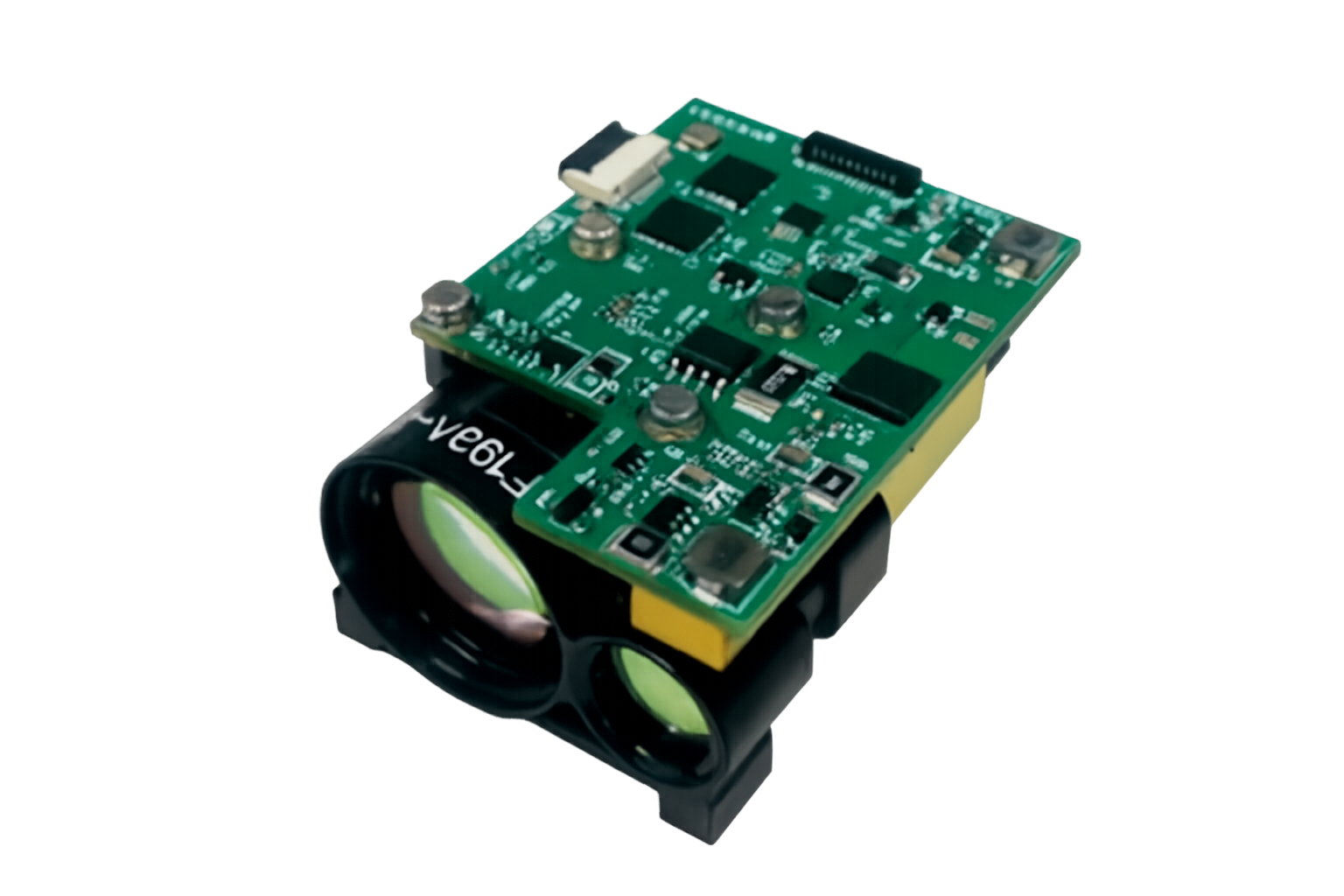
A laser rangefinder module becomes useful only after it works correctly inside the complete optical system.
Check these specifications together:
ranging accuracy;
minimum distance;
repetition frequency;
beam divergence;
wavelength;
input voltage;
current and power demand;
communication interface;
dimensions and weight;
connector position;
mounting reference;
operating temperature;
optical-axis position.
A unit that reaches farther but cannot fit the enclosure is not the better choice. Neither is a compact unit that uses the wrong interface.
Think of the ranging unit as one member of a team. Its own numbers matter, but the finished equipment only works when every part fits together.
Target Reflectivity Can Change Usable Distance
Reflectivity affects how much light comes back toward the receiver.
Bright paint, concrete, vegetation, metal, dark coatings, and glass can behave differently. Surface angle matters too. A tilted target may direct much of the reflected energy away from the receiver.
This becomes more noticeable as distance increases because the return signal is already weak.
If you know the target material, share it. If you do not know the exact reflectivity, a plain description such as “dark vehicle,” “concrete wall,” or “painted metal structure” is still useful.
Beam Divergence and Spot Size
Beam divergence describes how quickly the transmitted beam spreads.
A simple estimate is:
spot diameter ≈ distance × divergence
With 0.5 mrad divergence, the footprint is roughly 5 m at 10 km and 10 m at 20 km. At 0.3 mrad, the rough figures are about 3 m and 6 m.
Why Beam Footprint Matters at Long Distance
Think about a flashlight aimed at a wall. Close to the wall, the bright patch is small. Move farther away and it grows.
A laser is much narrower, but the same basic idea applies.
When the footprint becomes larger than the target, only part of the transmitted energy reaches the object you care about. A narrower beam can keep more energy on a smaller target, but it asks more from pointing accuracy and alignment.
Divergence should always be read together with target size and host stability.
Visibility Can Change the Range You Get Outdoors
The beam travels through the atmosphere twice: once toward the target and once back to the receiver.
Haze scatters light. Dust can do the same. Humidity, rain, smoke, and hot-air turbulence can weaken a long optical path.
For 3–4 km equipment, poor weather can still matter. At 12–20 km, it can become a deciding factor.
If the equipment is intended for coastal areas, hot roads, desert environments, industrial sites, or locations with frequent haze, include that information in the technical request.
Do Not Ignore the Optical Window
Many OEM products place the ranging unit behind a protective window. That window is part of the optical system.
Check:
window material;
transmission at the operating wavelength;
anti-reflection coating;
clear aperture;
mounting angle;
spacing from the transmitter and receiver;
possible internal reflections.
A poorly chosen window can weaken both the outgoing beam and the returning signal. It may also clip part of the optical path or send stray reflections toward the receiver.
Confirm the window before the enclosure is frozen. Late changes can affect mounting parts, sealing, and alignment.
Wavelength and Eye-Safety Considerations
Many long-distance OEM ranging products use wavelengths around 1535 nm. This spectral region is widely used in eye-safety-oriented laser products, but wavelength alone does not determine laser safety.
Pulse energy, pulse duration, repetition behavior, aperture, external optics, exposure conditions, and the applicable safety standard all matter.
Do not assume that “1535 nm” automatically gives a finished product a particular safety class. Ask for the relevant classification or the laser parameters needed by the team responsible for compliance.
Electrical Interface Can Decide Whether Integration Is Easy
Mechanical fit gets plenty of attention, yet electrical compatibility can stop a project just as quickly.
Before ordering, confirm input voltage, peak current, average power, grounding, connector pinout, trigger input, baud rate, and message format.
TTL or RS-422?
TTL is commonly used for short internal connections where cable length is small and the electrical environment is controlled.
RS-422 uses differential signaling and is often a better fit when cable runs are longer or surrounding electronics create more noise.
The interface name is only the first check. Two RS-422 products can still use different baud rates or command formats. Ask for the communication protocol early enough for the host controller firmware to be prepared around it.
Mechanical Fit Is More Than Length × Width × Height
A housing may fit inside the CAD envelope while assembly still fails.
Where does the connector exit? Can the cable bend without hitting another component? Can technicians reach the mounting screws? Is there room to adjust the optical axis? Does the unit need contact with a metal surface for heat transfer?
Weight matters too, particularly on moving optical equipment. Extra mass changes balance and inertia.
When possible, send the available installation space or a mechanical drawing to the supplier. “Please make it small” leaves too much room for misunderstanding.
When Customization Makes Sense
A standard product may meet nearly every requirement while one detail blocks installation.
That detail might be a different input voltage, another interface, a different connector, revised mounting holes, a shorter cable, a particular cable direction, a smaller housing, or a specific optical-axis position.
This is where an OEM manufacturer can be useful.
CSOPT Limited supplies laser ranging products across several distance classes from 3 km to 20 km and can provide project-specific customization for OEM customers. Customers can discuss electrical, mechanical, optical, and communication requirements around the host equipment rather than working only from a fixed catalog item.
Customization is most valuable when it removes extra brackets, adapter boards, cables, or other parts from the finished assembly.
What to Send Before Requesting a Quote
Writing “I need an 8 km unit” usually starts a long email chain. A better request gives the supplier enough context from the beginning.
A supplier can make a much better match when these details arrive together.
Choosing the Right Range Without Overbuying
It is tempting to buy more range “just in case.”
Sometimes that extra margin is useful. Sometimes it only adds size, weight, electrical demand, and cost.
Start with the hardest real operating condition.
If the target must be measured at 6 km in haze, that requirement matters more than reaching 10 km on a large bright building during a clear day. If the complete optical unit must stay below a strict weight limit, a compact 4 km product may be a better engineering choice than a larger unit with reach that will never be used.
The best choice is not the longest-range product. It is the one that leaves enough margin while fitting the rest of the equipment cleanly.
A well-chosen laser rangefinder module should almost disappear into the finished product: it fits, communicates correctly, stays aligned, and delivers the distance readings the user expects. For OEM projects from 3 km to 20 km, target conditions and integration details deserve as much attention as maximum range. Give the supplier a clear description of the working scene, and selection becomes faster and far less dependent on guesswork.
Frequently Asked Questions
1. Should I choose an 8 km unit if my maximum working distance is 6 km?
It can make sense when the extra distance gives useful margin for target surface, haze, window loss, or other field conditions. Size, weight, power, and the target itself still need to fit the project.
2. Is a 20 km product automatically better than a 12 km product?
No. Longer range can bring trade-offs in packaging, weight, electrical demand, and cost. If the host only needs 10–12 km, the smaller option may fit much better.
3. How much does target reflectivity affect ranging distance?
It can make a major difference. A large bright surface can return far more usable laser energy than a small dark or sharply angled target.
4. What matters most when installing the unit behind an optical window?
Transmission at the operating wavelength, coating, aperture, mounting angle, spacing, and unwanted reflections all deserve attention. The window affects both outgoing and returning light.
5. Can CSOPT Limited customize a unit for OEM equipment?
Yes. CSOPT Limited can provide customized services around distance class, input voltage, communication interface, mechanical envelope, connector arrangement, mounting features, and other integration needs. A clear equipment specification makes it easier to identify a suitable configuration.