
Why 1535 nm Is Used in Laser Rangefinder Modules
When engineers start looking at long-range laser ranging modules, one number appears surprisingly often: 1535 nm.
It is used in compact modules for EO/IR payloads, handheld optics, observation equipment, vehicle-mounted optical systems, and many other products where distance measurement has to work over several kilometers.
Why 1535 nm?
The answer is not simply “because it is eye-safe.” That phrase only tells part of the story.
A useful laser wavelength has to work with the laser source, receiver, optics, atmosphere, target, mechanical package, and safety requirements at the same time. At around 1535 nm, several of these requirements line up particularly well.
That is why this wavelength has become a practical choice for compact long-range laser ranging equipment.
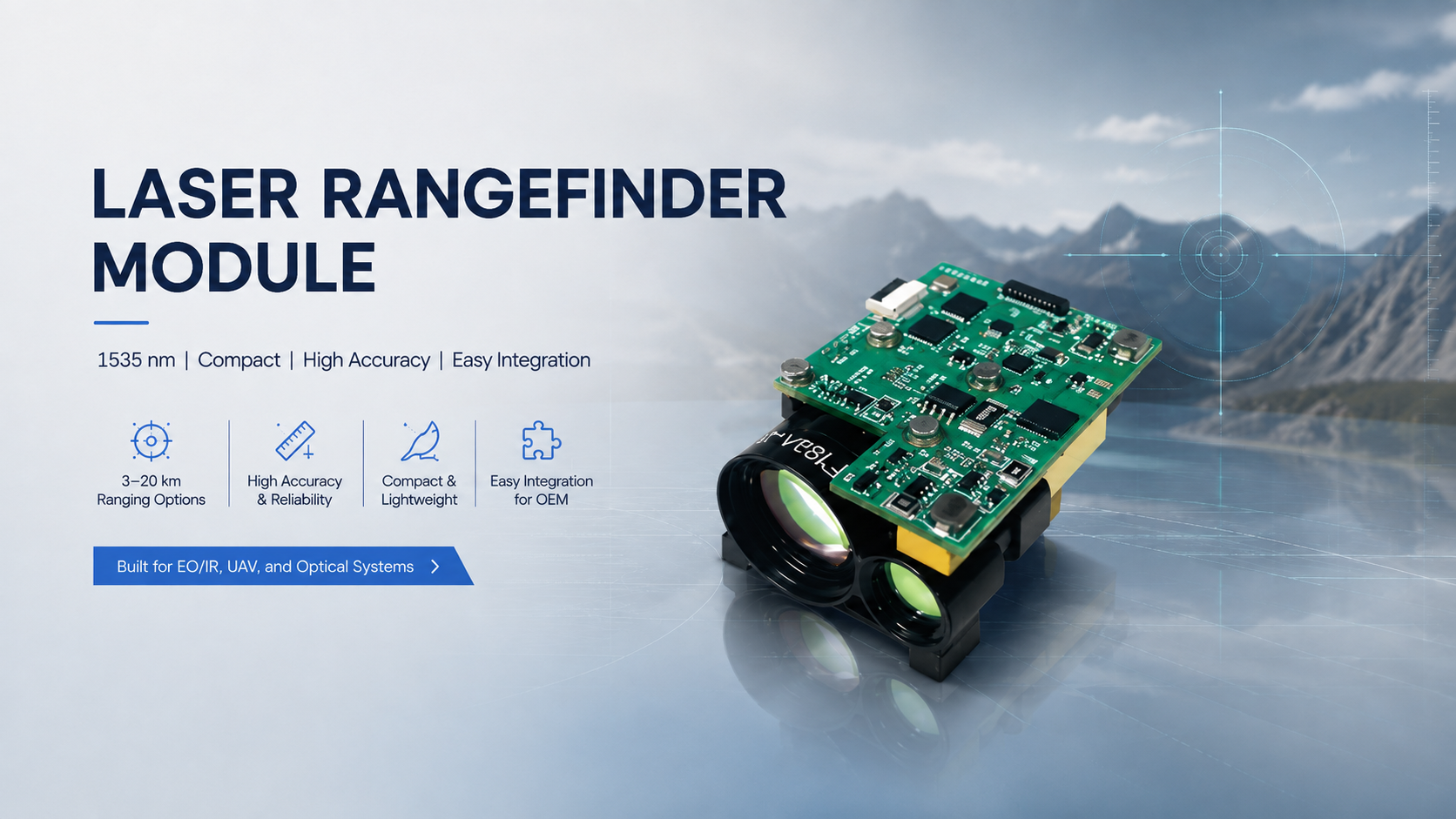
Why Wavelength Matters in a 1535 nm Laser Rangefinder
A laser rangefinder measures distance by sending a short pulse toward a target and detecting the reflected light.
The calculation itself is straightforward. Light travels to the target, returns to the receiver, and the electronics calculate distance from the round-trip travel time.
The difficult part is getting enough useful light back.
A pulse travelling several kilometers becomes weaker before it even reaches the target. Only part of the light hits the object. Only a fraction of that light is reflected toward the receiver. The returning pulse then travels through the atmosphere again before entering the receiving optics.
The wavelength influences almost every part of this optical path.
This is why wavelength selection cannot be separated from the rest of the ranging system.
What Makes a 1535 nm Laser Rangefinder Attractive?
The main attraction comes from a useful combination of optical characteristics.
At around 1535 nm, much of the incoming laser energy is absorbed in the front structures of the human eye rather than passing efficiently through the eye and being focused onto the retina.
At the same time, erbium-based glass laser sources can generate short pulses near this wavelength, while InGaAs detectors work well in the same spectral region.
That gives engineers a practical transmitter-and-receiver pair.
The wavelength also sits in a region that can work well for outdoor optical transmission, which is important once the measuring distance moves from hundreds of meters into several kilometers.
No single feature explains the popularity of 1535 nm. Its value comes from the way these properties work together.
1535 nm Laser Rangefinder Eye Safety Explained
The phrase 1535 nm laser rangefinder eye safety is often misunderstood.
A better way to describe the wavelength is that it can reduce retinal hazard compared with many shorter near-infrared wavelengths.
The eye is very good at focusing visible and certain near-infrared wavelengths onto the retina. That focusing action can concentrate optical energy onto a tiny area.
Around the 1.5 µm region, absorption by water-rich tissue in the cornea and front portions of the eye becomes much stronger. Much less energy reaches the retina.
This is one reason a 1535 nm eye safe laser rangefinder is attractive for equipment that may operate near people or be integrated into optical viewing systems.
That does not mean any laser operating at 1535 nm is automatically harmless.
Laser safety still depends on factors such as:
pulse energy;
pulse width;
repetition frequency;
beam diameter;
divergence;
aperture;
viewing distance;
accessible emission from the finished equipment.
A wavelength can provide a useful safety advantage without removing the need for proper laser classification.
“Eye-Safe” Does Not Mean Unlimited Laser Power
This distinction matters when reading product specifications.
Two laser ranging modules may both operate near 1535 nm but have very different emission characteristics.
One may run at a low repetition rate with relatively high pulse energy. Another may use lower-energy pulses at a higher repetition frequency. Their safety classifications do not automatically become identical just because the wavelength is similar.
For OEM equipment, laser safety should be considered at finished-system level.
The host optics, protective window, optical aperture, operating mode, and user access can all affect the final assessment.
It is better to treat 1535 nm as a wavelength with favorable eye-exposure characteristics rather than as a guarantee that every configuration is safe under every condition.
Why Er Is Commonly Used Near 1535 nm
The transmitter is one of the biggest reasons 1535 nm works well for compact rangefinders.
Erbium-doped glass can emit laser light in the 1.5 µm region. Erbium/ytterbium co-doped glass is also widely used, with ytterbium helping absorb pump light and transfer energy to erbium ions.
This makes it possible to build compact pulsed laser sources suitable for time-of-flight ranging.
A typical optical chain may include:
This combination is one reason the 1535 nm Er glass laser rangefinder is common in compact long-distance equipment.
Why Short Laser Pulses Are Useful for Ranging
Think about shouting toward a distant wall and listening for the echo.
A laser rangefinder works on a similar idea, except the signal travels at the speed of light.
The outgoing pulse creates a clear starting point. The reflected pulse provides the return point. The electronics measure the time between them.
The basic relationship is:
Distance = speed of light × round-trip time ÷ 2
The shorter and cleaner the optical pulse is, the easier it becomes for the electronics to identify its timing accurately.
Pulse width is not the only factor that controls ranging accuracy, but it is an important part of the transmitter architecture.
Receiver bandwidth, signal-to-noise ratio, timing electronics, target shape, and internal calibration also affect the final distance reading.
1535 nm Laser Rangefinder Wavelength and Outdoor Transmission
A long-range module does not measure distance through empty space.
It measures through air.
That means the outgoing and returning light may pass through humidity, haze, dust, rain, thermal turbulence, and other atmospheric conditions.
The 1535 nm laser rangefinder wavelength lies in a useful near-infrared transmission region, making it suitable for outdoor ranging when the complete optical link is properly engineered.
Yet outdoor performance should never be described by wavelength alone.
A module rated for several kilometers on a clear day does not automatically deliver the same distance through heavy haze.
The atmospheric path can weaken the pulse twice:
transmitter → target → receiver
For long-range measurement, even moderate optical loss becomes important because the return signal may already be extremely weak.
What Happens in Haze, Rain, Dust, and Fog?
Poor visibility can reduce usable ranging distance sharply.
Fog is particularly difficult because suspended droplets scatter and absorb part of the transmitted energy. The receiver may also detect backscatter from the atmosphere itself.
Dust and haze can create similar issues, especially across long paths.
Rain can reduce transmission and introduce additional optical interference, though the effect depends on rainfall intensity, distance, beam geometry, and receiver settings.
This is why a distance rating should always be read together with target and environmental conditions.
A 10 km measurement against a large reflective building in clear weather is very different from trying to measure a small, dark target at the same distance through haze.
The distance number may look identical on paper. The optical task is not.
Why InGaAs Receivers Work Well at 1535 nm
Producing a strong outgoing pulse is only half of a laser rangefinder.
The receiver often has the harder job.
After several kilometers of propagation and reflection, the optical signal entering the receiver may be extremely weak.
Silicon detectors are widely used at shorter wavelengths, including many 905 nm ranging products. Their spectral response does not extend efficiently into the 1535 nm region.
InGaAs detectors are much better suited to the 1.5 µm band.
They can provide good sensitivity around this wavelength and are commonly used where weak near-infrared signals need to be detected quickly.
Receiver Performance in 1535 nm Laser Ranging Technology
A sensitive detector does not automatically create a long-range unit.
Receiver performance comes from several parts working together:
This is one reason 1535 nm laser ranging technology should be viewed as a complete optical system rather than just a laser source.
A powerful transmitter paired with a weak receiver can still perform poorly.
It is like shouting across a large field while the person at the other end is wearing earplugs.
Main Advantages of 1535 nm Laser Rangefinder Systems
The practical advantages of 1535 nm laser rangefinder equipment become clearer when the whole system is considered.
1. Favorable Eye-Exposure Characteristics
The reduced transmission of 1.5 µm light to the retina gives engineers more flexibility when building ranging equipment that operates around people or optical viewing devices.
2. Compact Pulsed Laser Sources
Er-based glass lasers can generate useful pulses while remaining small enough for OEM modules.
3. Suitable Receiver Technology
InGaAs detectors work well in the same spectral region, which gives the transmitter and receiver a natural pairing.
4. Good Fit for Kilometer-Class Ranging
The wavelength is well suited to many applications where the required distance moves beyond short consumer-style measurement.
5. Suitable for Compact Optical Platforms
A laser ranging module can be integrated into systems where size and weight are tightly controlled.
These advantages explain why 1535 nm is widely seen in higher-performance compact ranging equipment.
Why 1535 nm Works Well in Compact Laser Ranging Modules
An OEM engineer rarely has unlimited space.
A laser rangefinder may need to share a housing with a visible camera, thermal camera, control board, IMU, motors, stabilization hardware, communication electronics, and power circuits.
Weight matters too.
A few extra grams placed far from the rotation axis can affect balance in a stabilized optical payload. A larger housing may also force changes to the mechanical structure around it.
This is where compact laser sources and receivers become valuable.
CSOPT Limited supplies laser ranging modules for integration into EO/IR payloads, handheld optics, vehicle-mounted equipment, observation devices, and customized optoelectronic systems.
Current product options cover multiple distance classes from several kilometers up to long-range configurations, allowing the module size, electrical requirements, interface, and ranging capability to be matched more closely to the host equipment.
1535 nm vs 905 nm: The Difference Is More Than Wavelength
905 nm is also widely used in laser distance measurement.
It has a strong semiconductor emitter ecosystem and works well with silicon receivers. This can make it attractive for short-range equipment, compact sensors, and cost-sensitive products.
Moving to 1535 nm changes several parts of the optical chain.
This table should not be read as a rule that one wavelength is always better.
The right choice depends on the actual application.
A 1535 nm Laser Rangefinder Does Not Automatically Reach Farther
This is one of the most important points for buyers.
Wavelength does not determine maximum distance by itself.
A module may use 1535 nm and still have poor long-range performance if the beam spreads too quickly, the receiving aperture is too small, the detector is noisy, or the transmitter does not produce enough useful pulse energy.
Real ranging distance depends on several factors working together:
target size;
target reflectivity;
pulse energy;
beam divergence;
receiver aperture;
detector sensitivity;
optical losses;
visibility;
alignment;
signal processing.
A useful wavelength gives engineers a strong foundation.
The rest of the rangefinder still has to be engineered properly.
Beam Divergence Still Matters at 1535 nm
Laser beams expand as they travel.
Beam divergence tells you how quickly that happens.
A value such as 0.3 mrad may look tiny on a specification sheet. At several kilometers, it is no longer tiny.
Using a simple approximation:
These figures illustrate why divergence matters when the target is small.
If the beam footprint becomes much larger than the target, only part of the transmitted energy lands on the object.
Less energy on the target usually means less useful reflected energy reaching the receiver.
Narrower Is Not Always Better
A very narrow beam can concentrate more energy onto the target, but it also demands better pointing accuracy.
This becomes important on moving platforms.
Imagine trying to shine a laser pointer onto a small sign several kilometers away while standing on a moving vehicle. A tiny angular error becomes a large position error at long distance.
The same issue appears in stabilized EO systems, UAV payloads, moving observation equipment, and other platforms.
Beam divergence must be balanced against:
target dimensions;
platform motion;
pointing accuracy;
optical alignment;
mechanical stability;
required range.
The smallest divergence number is not automatically the best choice for every system.
Choosing a 1535 nm Laser Rangefinder for OEM Integration
A common purchasing mistake is starting with only one requirement:
“We need a 10 km laser rangefinder.”
That is not enough information to choose a suitable module.
A useful supplier discussion should start with the real operating conditions.
This information gives the manufacturer a much clearer picture of the job the module actually has to do.
Match the Module to the Target, Not Just the Distance
Target characteristics can change ranging performance dramatically.
A large, light-colored wall may return plenty of optical energy.
A small dark object at the same distance may return much less.
Target angle matters as well. A surface facing the rangefinder can reflect differently from the same surface tilted away from the optical axis.
This is why buyers should ask what type of target was used when a manufacturer states a maximum ranging distance.
A distance specification becomes much more useful once you know:
target dimensions;
reflectivity;
visibility;
measurement frequency;
atmospheric conditions.
Without that information, one distance number tells only part of the story.
Do Not Choose a Module by Maximum Range Alone
Maximum distance often gets the most attention, yet it is only one specification.
For a practical OEM project, engineers should also check:
minimum ranging distance;
ranging accuracy;
beam divergence;
repetition frequency;
operating wavelength;
supply voltage;
power consumption;
communication interface;
dimensions;
weight;
connector direction;
operating temperature;
external optical window.
A 20 km module may look attractive, but it may be unnecessary if the real task never exceeds 6 km.
Using an oversized module can increase cost, power consumption, mass, and integration difficulty without improving the actual product.
The better module is the one that fits the real operating envelope.
Optical Windows Can Quietly Reduce Ranging Performance
Many OEM systems place the laser ranging module behind an external protective window.
That window is easy to overlook.
A material may look perfectly clear to the human eye while having different transmission characteristics around 1535 nm.
Coatings matter too.
A poor window can introduce:
transmission loss;
unwanted reflections;
stray light;
beam distortion;
receiver signal loss.
The installation angle can also matter.
If the window is tilted or positioned too close to the transmit and receive optics, internal reflections may enter the receiver and create unwanted signals.
When integrating a laser ranging module, window material and coating should be checked at the actual operating wavelength rather than judged by visible appearance.
How CSOPT Limited Uses 1535 nm Laser Ranging Modules
CSOPT Limited manufactures compact laser ranging modules for OEM optical systems and can provide customized configurations based on project requirements.
The product range includes modules intended for different distance classes, from shorter kilometer-class measurement to long-range applications.
Typical integration platforms include:
EO/IR gimbals;
handheld optical devices;
vehicle-mounted optical systems;
observation equipment;
custom optoelectronic systems.
Depending on the project, customers may need different electrical interfaces, supply voltages, repetition frequencies, connector arrangements, dimensions, weights, or mechanical installation requirements.
This is why customization often matters as much as the headline ranging distance.
A module that performs well optically still needs to fit the host equipment mechanically and electrically.
What 1535 nm Really Brings to a Laser Rangefinder
1535 nm has become a practical wavelength for long-distance compact ranging because several useful characteristics meet in the same spectral region.
It offers favorable retinal exposure characteristics, works with compact Er-based pulsed laser sources, matches well with InGaAs receivers, and can perform effectively in outdoor ranging systems.
That does not make wavelength the only thing that matters.
Target reflectivity, target size, beam divergence, receiver aperture, pulse energy, visibility, optical windows, detector sensitivity, and mechanical integration can all change the distance a module can reach in real operation.
For an OEM buyer, the best question is not simply:
“Is 1535 nm better?”
A much more useful question is:
“Does this 1535 nm laser ranging module match my target, distance, platform, optics, and electrical limits?”
Once those requirements are clear, selecting the right module becomes much easier.
Frequently Asked Questions
1. Why is 1535 nm commonly used in long-range laser rangefinders?
The wavelength combines favorable eye-exposure characteristics with compact Er-based pulsed laser sources, suitable InGaAs receiver technology, and useful outdoor transmission. This combination makes it attractive for kilometer-class ranging equipment.
2. Is every 1535 nm laser automatically eye-safe?
No. Wavelength is only one part of laser safety. Pulse energy, pulse duration, repetition frequency, aperture, divergence, and the finished equipment configuration also affect safety classification.
3. Why are InGaAs detectors used with 1535 nm lasers?
Standard silicon detectors are not efficient at 1535 nm. InGaAs detectors have strong sensitivity in the 1.5 µm region and are well suited to detecting weak return pulses from distant targets.
4. Does a 1535 nm laser rangefinder always reach farther than a 905 nm unit?
No. Maximum distance depends on the complete optical link, including pulse energy, beam divergence, target reflectivity, target dimensions, receiver aperture, detector performance, visibility, and optical losses.
5. What should I provide when requesting a customized laser ranging module from CSOPT Limited?
Provide the target type, approximate target dimensions, expected reflectivity, normal operating distance, farthest required distance, typical visibility, host platform, available power, communication interface, size and weight limits, optical-window information, and expected quantity. These details make it much easier to match the module to the real application.