
905 nm vs 1535 nm Laser Rangefinder Module: Which One Fits Your System?
Choosing between 905 nm and 1535 nm looks easy when you are reading a specification sheet. Both can measure distance with pulsed time-of-flight technology, and both are available in compact modules.
The difference becomes much clearer once the rangefinder has to work inside real equipment.
An EO/IR payload may have strict limits on size, weight, voltage, heat, optical window transmission, and boresight accuracy. A handheld optic may put laser safety and battery life near the top of the list. A vehicle-mounted system may need several kilometers of useful range while dealing with vibration, haze, and moving targets.
At that point, wavelength is no longer an isolated specification. It affects the transmitter, receiver, optics, cost, laser class, and practical integration of the complete unit.
For an OEM buyer, the useful question is not simply, “Is 1535 nm better than 905 nm?”
A better question is:
Which wavelength gives my equipment enough ranging performance without adding unnecessary cost, size, power consumption, or integration work?
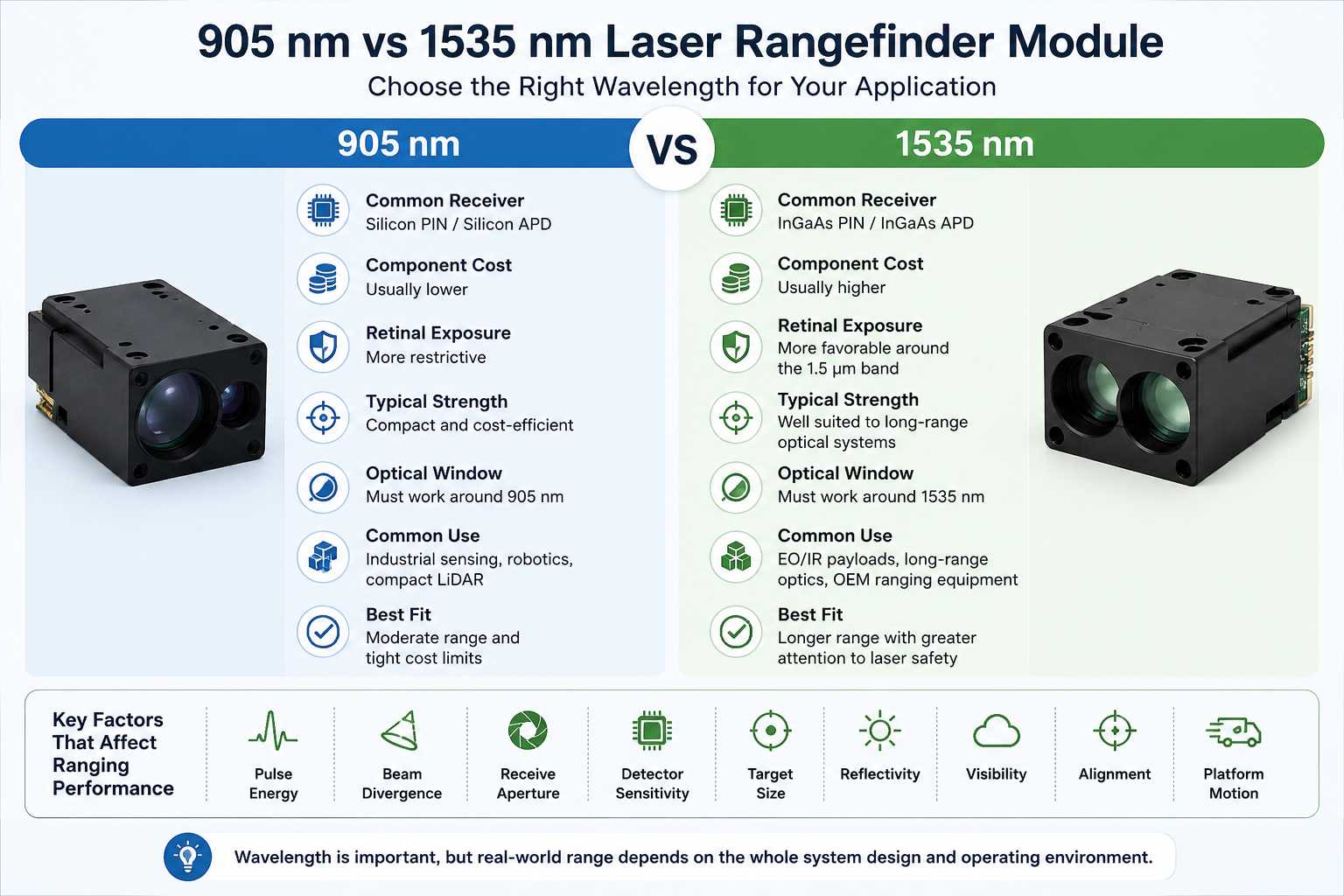
1535 nm vs 905 nm Laser Rangefinder: Quick Comparison
The main differences can be seen quickly in the table below.
This table is useful for the first screening, but it should not be treated as a range ranking.
A good 905 nm unit can outperform a poorly matched 1535 nm unit. Maximum distance depends on the complete optical chain, not the wavelength printed on the label.
How Laser Ranging Works at 905 nm and 1535 nm
Most compact pulsed rangefinders work in roughly the same way.
The transmitter sends out a short laser pulse. The target reflects a small portion of that light. The receiver detects the returning signal, and the electronics calculate distance from the round-trip travel time.
The basic ranging principle remains the same at both wavelengths.
The hardware around it does not.
The laser source must operate efficiently at the selected wavelength. The receiver must be sensitive in the same spectral region. Optical filters, coatings, protective windows, receiver electronics, and thermal behavior must also match.
This is why changing from 905 nm to 1535 nm is rarely as simple as replacing one laser diode.
What You Usually Find in a 905 nm Rangefinder
905 nm works well with silicon detectors.
Silicon photodiodes and silicon avalanche photodiodes are mature, widely available components. Pulsed 905 nm laser diodes are also common.
That combination makes 905 nm attractive when a manufacturer wants a compact unit without pushing component cost too high.
You will often find it in:
industrial distance sensors;
robotics;
compact LiDAR;
consumer optical equipment;
shorter-range measuring devices;
equipment with a relatively controlled optical path.
For these products, 905 nm can offer a very practical balance between price, size, and useful distance.
What Changes in a 1535 nm Laser Rangefinder Module
A 1535 nm laser rangefinder module normally uses an InGaAs receiver because standard silicon detectors are no longer efficient at this wavelength.
That change affects more than the detector itself.
The receiver electronics, optical filters, coatings, transmitter source, power requirements, and package can all be different.
InGaAs components also tend to cost more than standard silicon parts.
Why accept that extra cost?
For many long-range systems, the answer is connected to laser safety and the amount of useful optical energy that can be transmitted.
Why Choose a 1535 nm Laser Rangefinder Module?
The main attraction of 1535 nm is not that this wavelength automatically travels farther through the air.
Its biggest advantage comes from the way light around 1.5 µm interacts with the human eye.
At 905 nm, part of the incoming laser energy can reach the retina. Around 1535 nm, much more of the energy is absorbed in the front structures of the eye before it reaches the retina.
That gives engineers a more favorable safety margin when developing pulsed ranging equipment.
In long-distance systems, that extra margin can be valuable because the transmitter needs enough pulse energy to produce a detectable return after several kilometers of travel.
Why 1535 nm Is Commonly Called Eye-Safe
The phrase 1535 nm eye safe laser is common in the laser-ranging industry, but it should not be read as “harmless laser.”
1535 nm offers a much more favorable retinal safety characteristic than wavelengths such as 905 nm.
The finished laser class still depends on several items:
pulse energy;
pulse duration;
beam diameter;
beam divergence;
repetition rate;
accessible emission;
viewing conditions.
A high-energy 1535 nm source can still damage the eye.
The safer wording is that the 1.5 µm band offers a more favorable eye-safety margin, rather than saying the wavelength itself is completely safe.
Eye-Safe Depends on the Finished Optical System
This point matters when an eye safe laser rangefinder module is installed inside another product.
Imagine that the module meets the expected laser class during bench verification. You then place it behind a protective window, telescope, or shared EO/IR optical channel.
The outgoing beam may no longer behave exactly as it did before installation.
Window reflections, additional lenses, beam clipping, or changes in beam diameter can affect the optical path.
The finished host equipment needs to be considered as a complete optical system.
Does 1535 nm Measure Farther Than 905 nm?
Not automatically.
Long-distance ranging is essentially a fight to recover a very weak return signal.
A small amount of laser energy leaves the transmitter, spreads as it travels, hits the target, scatters in many directions, and only a tiny portion comes back through the receiver aperture.
Several items decide whether that returning pulse is strong enough to detect.
This is why comparing two products only by wavelength rarely tells you which one will reach farther.
Pulse Energy Becomes Critical at Long Distance
At several kilometers, the receiver sees only a tiny fraction of the emitted pulse.
More pulse energy can improve the return, provided the product remains within its required laser class.
This is one area where 1535 nm becomes attractive.
Its more favorable retinal safety characteristics can give engineers more room when balancing transmitted energy and long-range performance.
That benefit still needs a good receiver.
A powerful transmitter paired with weak optics or a noisy receiver will not suddenly create a strong long-distance rangefinder.
Beam Divergence Can Change the Real Range Dramatically
Beam divergence tells you how quickly the laser spot grows as distance increases.
Take a 0.5 mrad beam as a simple illustration.
At 1 km, the geometric spread is roughly 0.5 m. At 10 km, it is roughly 5 m.
The farther the target is, the larger the illuminated area becomes.
A narrow beam can put more energy onto a small target, but a very narrow beam also demands better pointing accuracy.
That trade-off matters inside EO/IR gimbals.
A very tight beam looks impressive on paper. If the gimbal shakes slightly or the laser boresight shifts, the beam may no longer hit the intended target.
Target Size and Surface Matter Just as Much
An 8 km specification has little meaning without knowing what was measured.
A large building wall is very different from a small dark object.
Surface finish matters too.
A bright, nearly perpendicular surface can return a much stronger signal than a dark, angled target at the same distance.
When evaluating a laser ranging module, ask:
What target size was used?
What surface reflectivity was assumed?
What visibility was available?
Was the platform fixed or moving?
Those answers are often more useful than the headline distance.
Weather Can Reduce the Range of Either Wavelength
Fog, haze, rain, dust, humidity, and strong thermal turbulence can reduce ranging performance.
Neither wavelength should be treated as a universal bad-weather solution.
A 1535 nm unit that reaches a distant target in clear air may show a much shorter usable distance in heavy haze.
The same is true for 905 nm.
If your equipment will be used outdoors, define typical visibility before selecting the range class.
905 nm vs 1535 nm Detector Cost
The receiver is one of the clearest cost differences between these two wavelength bands.
905 nm Works Well with Silicon
Silicon detectors perform well around 905 nm and are widely available.
That makes 905 nm attractive for products where component cost and compact packaging carry more weight than extreme distance.
For high-volume industrial equipment, this difference can matter a lot.
It is one reason 905 nm remains common even though 1535 nm has attractive laser-safety characteristics.
A 1535 nm Laser Rangefinder Module Usually Uses InGaAs
A 1535 nm laser rangefinder module normally uses an InGaAs detector.
InGaAs devices are suited to the 1.5 µm region but tend to cost more than standard silicon parts. Receiver electronics can also become more demanding.
The extra cost becomes easier to justify when the equipment needs:
several kilometers of useful reach;
stricter laser-safety requirements;
a long-range optical payload;
a system already built around the 1.5 µm band.
A buyer should look at the complete receiver chain rather than comparing only the price of the laser source.
Optical Windows Can Quietly Reduce Ranging Distance
Many OEM rangefinders do not operate directly in open air.
They sit behind a protective optical window.
That window can become one of the weakest parts of the installation if its material or coating does not match the laser wavelength.
A substrate may transmit both 905 nm and 1535 nm, while its anti-reflection coating performs well at only one of them.
Internal reflection is another concern.
Part of the outgoing laser pulse can reflect from the window back into the receiver. That creates a strong near-field return before the real target echo arrives.
What to Check Before Placing the Module Behind a Window
For EO/IR payload builders, this is worth checking early.
Changing a window after the mechanical structure is finished is far more difficult than selecting the right coating at the start.
Mechanical Alignment Matters at Long Distance
A small angular error becomes a large positional error several kilometers away.
The transmitter axis, receiver field of view, telescope, window, and host boresight need to remain aligned during operation.
Temperature changes can shift mechanical parts slightly.
Vibration can do the same.
A vehicle-mounted or airborne payload adds another layer because the whole platform may be moving while the measurement is taking place.
This is why beam divergence and pointing accuracy should be considered together.
A narrow laser beam is useful only if the host equipment can keep it on the target.
Power and Communication Must Fit the Host Equipment
Optical performance is only one part of OEM integration.
The rangefinder also needs to fit the host electrically.
Check:
input voltage;
peak current;
average power;
grounding;
communication interface;
command format;
cable length;
available cooling path.
TTL and RS-422 are common interfaces for embedded ranging equipment.
Which one fits better depends on cable length, electrical noise, controller layout, and the rest of the host electronics.
When 905 nm Is Still the Better Choice
905 nm should not be treated as an outdated wavelength.
For many products, it is exactly the right choice.
Suppose an industrial sensor only needs to measure several hundred meters. The unit must be small, inexpensive, and produced in volume.
A costly long-range optical architecture brings little benefit there.
905 nm is worth considering when:
the required distance is short or medium;
silicon detector cost matters;
the package must stay compact;
targets are reasonably reflective;
the optical path is controlled;
the required laser class can be met comfortably.
In those situations, choosing 1535 nm simply because it sounds more advanced can add cost without adding useful performance.
1535 nm Laser Rangefinder Applications
A 1535 nm laser rangefinder module becomes more attractive when the equipment needs long-distance measurement while keeping laser safety firmly in view.
Typical uses include:
EO/IR payloads;
handheld optical instruments;
vehicle-mounted observation systems;
surveying equipment;
long-range optoelectronic equipment;
custom OEM optical platforms.
These applications often need more than a simple distance reading.
The ranging unit must share limited space with cameras, thermal imagers, stabilization hardware, processors, and communication electronics.
Why 1535 nm Laser Rangefinder Is Popular in Long-Range Optics
Long-range optical equipment needs enough transmitted energy to create a usable return from a distant target.
The transmitter cannot simply keep increasing laser power without considering safety.
This is where the 1.5 µm band becomes useful.
The more favorable retinal safety margin gives engineers more room to balance pulse energy with the required laser class.
That does not make 1535 nm the right choice for every application. It makes it particularly attractive when useful range extends into several kilometers.
CSOPT 1535 nm Laser Rangefinder Module Options
CSOPT Limited supplies 1535 nm laser ranging modules for OEM integration.
Our current product range includes distance classes of:
3 km, 4 km, 6 km, 8 km, 12 km, 18 km, and 20 km.
These modules can be integrated into EO/IR payloads, handheld optical equipment, vehicle-mounted systems, observation equipment, and other optoelectronic products.
CSOPT can also provide customized services when the standard configuration does not fit the host equipment.
Customization may involve interface requirements, installation constraints, electrical requirements, or other integration details agreed for the project.
Do Not Choose the Longest Range First
A common purchasing mistake is starting with the largest distance number.
If the real working distance is 2–4 km, a 20 km unit may create unnecessary size, weight, power, and integration pressure.
Start from what the equipment actually needs.
This information tells far more about the right module than simply saying, “I need long range.”
What to Send CSOPT Before Requesting a Quote
A useful inquiry does not need to be long.
Tell us what you need to measure, the normal working distance, the farthest distance you genuinely need, approximate target size, typical visibility, host equipment, available voltage, communication interface, and maximum installation space.
If the module will sit inside an EO/IR gimbal, include the optical window details as well.
With those conditions clear, CSOPT can match a suitable standard unit or discuss a customized configuration.
905 nm or 1535 nm: Which One Should You Choose?
Choose 905 nm when compact size, silicon receiver cost, and moderate working distance are the strongest priorities.
Choose 1535 nm when the equipment needs longer-distance ranging and a more favorable retinal safety margin.
The wavelength itself should never make the entire decision.
Target size, reflectivity, visibility, beam divergence, receive aperture, pointing accuracy, optical window, voltage, interface, weight, and available installation space all affect whether the rangefinder will work well after integration.
A compact industrial sensor may be perfectly suited to 905 nm.
A long-range EO/IR payload may benefit much more from 1535 nm.
The best rangefinder is not the one with the largest distance printed on its page. It is the one that can reliably measure the real target, fit inside the host equipment, meet the required laser class, and retain enough margin for field conditions.
Frequently Asked Questions
1. Is 1535 nm always safer than 905 nm?
1535 nm offers a more favorable retinal safety characteristic because much more of the light is absorbed before reaching the retina.
The finished product still needs to meet its required laser class. Pulse energy, beam size, divergence, pulse duration, and repetition rate remain important.
2. Does 1535 nm always measure farther than 905 nm?
No.
Useful distance depends on transmitted energy, divergence, receive aperture, detector sensitivity, target reflectivity, visibility, alignment, and receiver performance.
1535 nm can be attractive for long-distance equipment, but wavelength alone does not determine maximum range.
3. Why are many 905 nm rangefinders cheaper?
905 nm works well with mature silicon detectors and widely available pulsed laser diodes.
A 1535 nm receiver normally requires InGaAs components, which can increase the cost of the receiver section.
4. Can the same optical window be used for 905 nm and 1535 nm?
Possibly, but it should be checked rather than assumed.
The substrate may transmit both wavelengths while the anti-reflection coating performs well at only one of them.
Check transmission, reflection, clear aperture, window angle, and internal stray light at the actual operating wavelength.
5. What should I provide when asking CSOPT for a 1535 nm rangefinder?
Provide the target type and approximate size, normal working distance, farthest required distance, visibility, host equipment, motion condition, available power, communication interface, size and weight limits, and optical-window information.
These details make it much easier to select a laser ranging module that fits the finished system rather than simply matching a distance number.