
Modern airspace defense faces an unprecedented threat environment: small commercial quadcopters flying beneath radar horizons, high-speed first-person-view (FPV) loitering munitions, and stealthy composite reconnaissance drones. While primary surveillance radar serves as the early detection baseline, raw radar returns alone rarely yield the fire-control precision needed for kinetic, airburst, or directed-energy defeat.
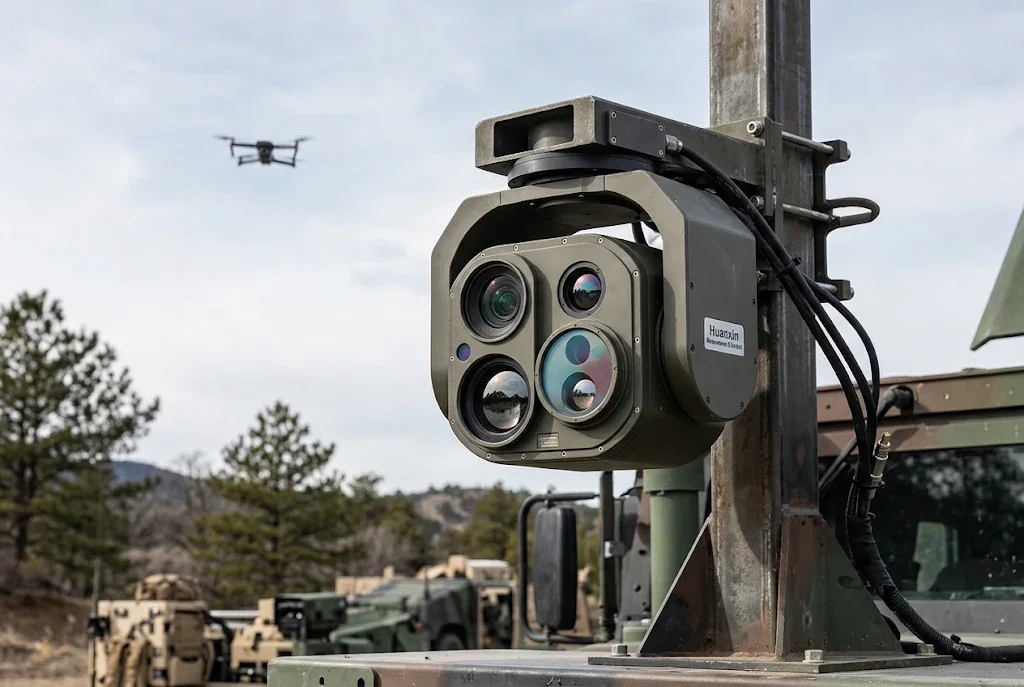
Bridging this gap requires slew-to-cue optronics, where radar track vectors steer electro-optical/infrared (EO/IR) turrets directly onto the target axis. However, visual locks provide only two-dimensional directional data. Integrating a high-performance C-UAS laser rangefinder operating at the eye-safe 1535nm wavelength supplies the critical line-of-sight distance, turning ambiguous radar plots into accurate 3D firing solutions.
The Sensor Handoff Gap in Counter-Drone Defense
Early-warning radar systems detect targets through radio frequency echoes, outputting azimuth, elevation, and coarse range estimates. For small unmanned aerial
systems (sUAS) with micro radar cross-sections (RCS < 0.01 m²), radar tracking suffers from distinct limitations:
Multipath reflections and ground clutter: Low-altitude drones flying over terrain, tree lines, or buildings induce multipath interference, causing radar tracks to stutter or drift.
Angular resolution degradation: At multi-kilometer boundaries, a radar's angular resolution cell expands significantly, producing positional error ellipses dozens of meters wide.
Target misclassification: Radar alone struggles to differentiate between a non-threatening bird, light clutter, and an armed drone.
To resolve these ambiguities, modern counter-drone suites slave high-magnification EO/IR cameras directly to radar track coordinates. Once the gimbal aligns with the radar vector, video auto-trackers lock onto the target's physical silhouette or thermal signature.
Why Slew-to-Cue Systems Demand Dedicated Laser Ranging
A video camera tracking a target provides angular bearings , but lacks absolute depth perception along the optical bore. Pixels alone cannot establish true spatial velocity or target size:
Kinematic Ambiguity: A 40 cm quadcopter at 500 meters occupies the exact same pixel dimensions on an image sensor as a 4-meter fixed-wing drone at 5 kilometers.
Fire-Control Inability: Automated 30mm/40mm programmable airburst guns require millimeter-accurate time-of-flight calculations and barrel lead angles. Without true distance, airburst rounds detonate harmlessly in empty air.
Directed-Energy and Jamming Dispersion: High-power RF jammers and laser countermeasure systems rely on precise beam convergence. Accurate range data ensures beam energy focuses directly on the target's internal receivers or structure.
Integrating a compact long range LRF module into the gimbal payload instantly completes the 3D spherical coordinate matrix ($r, \theta, \phi$), delivering deterministic range data directly into the fire-control computer.
1535nm Erbium-Glass: The Wavelength of Choice for Tactical Air Defense
Laser rangefinders typically operate across three primary wavelengths: 905nm, 1064nm, and 1535nm. For counter-drone applications, 1535nm erbium-glass solid-state technology has emerged as the definitive industry standard.
Wavelength Comparison Matrix
Retina Safety in Civil and Border Airspaces
Unlike 1064nm radiation, which passes through the human eye and focuses directly onto the retina to cause permanent blindness, 1535nm light is absorbed entirely by the cornea and ocular lens. This allows high-pulse-energy emissions within Class 1 and Class 3R safety standards. Counter-drone systems deployed near commercial flight paths, maritime ports, urban infrastructure, and friendly ground units can fire continuously without risking civilian or operator vision.
Covert Operation and Low Probability of Intercept
Legacy 1064nm lasers produce bright, telltale flashes on adversary Gen 2 and Gen 3 night vision goggles, instantly compromising defensive positions. The 1535nm spectrum falls completely outside the spectral sensitivity of standard silicon-based night vision sensors, ensuring the counter-drone battery maintains full tactical concealment.
Integrating a 10km Laser Rangefinder Module for Counter Drone Gimbal Payloads
Modern gimbal payloads—whether mounted on unmanned ground vehicles, light tactical trucks, naval vessels, or perimeter defense towers—operate under tight Size, Weight, and Power (SWaP) constraints.
A standard 10km laser rangefinder module for counter drone gimbal installations must deliver standoff performance without exceeding weight budgets:
Weight Budgets: Modules designed for gimbal payloads range from under 30g for ultra-light systems up to 130g–280g for extended 12km to 18km platforms.
Tight Beam Divergence: Ranging a sub-meter drone at 3km to 6km requires an optical beam divergence below 0.5 mrad (milliradians). A wider beam disperses optical energy into the open sky or background terrain, causing false returns or target misses.
Boresight Structural Rigidity: Thermal variation, continuous motor acceleration, and platform recoil can induce optical misalignment. Precision-engineered modules use optomechanical thermal compensation to preserve zero-drift boresight retention over operational ranges spanning -40°C to +65°C.
Real-Time Tracking Dynamics: High Repetition Rates for Moving Targets
Static structures or large maritime vessels can be ranged with low-frequency pulses (0.1 Hz to 1 Hz). However, modern loitering munitions and FPV interceptors dive and maneuver at speeds exceeding 100 km/h.
Deploying a laser rangefinder module high repetition rate for moving targets operating at continuous rates of 5 Hz, 10 Hz, or 20 Hz provides critical tracking advantages:
Dense Kinematic Data: High-rate pulsing feeds real-time updates directly into extended Kalman filter (EKF) tracking loops.
Vector Estimation: Real-time distance measurements eliminate tracking lag, enabling the system to estimate target acceleration vectors and compute accurate ballistic lead points.
Mitigating Signal Dropout: Erratic drone banking angles present transient reflective surfaces. Higher pulse frequencies ensure that brief signal drops do not derail the target track file.
EO/IR Radar Slaved Laser Ranging 1535nm Architecture
The integration pipeline of an EO/IR radar slaved laser ranging 1535nm payload follows a structured, closed-loop process flow:
Digital Control and Low Latency
Communication between the rangefinder module and the gimbal host processor relies on deterministic serial interfaces:
RS-422: Employs differential signaling to ensure high noise immunity across moving slip rings and vehicle wiring harnesses.
TTL: Serves ultra-compact board-level integrations requiring minimal footprint.
Deterministic latency guarantees that distance measurements correlate with the gimbal angular encoders within sub-millisecond windows, preventing georeferencing inaccuracies during rapid slewing.
Ranging Low-Reflectance Composite Targets
Modern military drones incorporate carbon-fiber structures, radar-absorbent coatings, and curved composite fairings with surface reflectances often falling below 10%. To capture returns from these targets, 1535nm modules pair InGaAs avalanche photodiode (APD) detectors with multi-pulse signal accumulation algorithms, isolating target returns from background ambient noise.
OEM Customization: Huanxin Measurement & Control Technology
Selecting the right rangefinder hardware requires balancing payload volume, detection ranges, and interface protocols. Huanxin Measurement & Control Technology Co., Ltd. specializes in developing and manufacturing standard and custom 1535nm laser rangefinder modules for OEM electro-optical integration.
Operating specialized Class 10,000 cleanrooms and testing facilities, Huanxin provides board-level modules spanning operational ranges from 3 km up to 20 km:
Micro Payloads: Compact modules weighing under 29g for miniature drone and handheld gimbals.
Tactical C-UAS Payloads: 10km to 12km modules (weighing ≤127g) optimized with low beam divergence and high repetition rates for dynamic aerial tracking.
Extended Standoff Modules: Heavy-duty systems measuring out to 18km–20km for long-range coastal and border defense platforms.
Huanxin works directly with system integrators to configure custom mechanical housings, optical alignments, communication protocols (TTL/RS-422), and firmware filtering for specific operating environments.
Technical Specifications Across Common C-UAS Rangefinder Modules
Summary of Operational Benefits
Integrating a 1535nm eye-safe laser rangefinder within a radar-slaved optronic gimbal resolves the core blind spots of counter-drone engagements:
Closes the Loop: Converts 2D sensor video tracking into fully resolved 3D fire-control targeting vectors.
Maintains Ocular Safety: Safe for deployment over urban areas, critical civil infrastructure, and populated bases.
Overcomes Target Defenses: Detects low-reflectance carbon-fiber drone airframes across challenging atmospheric environments.
Enables Real-Time Kinematics: Delivers high pulse repetition rates necessary to track, predict, and neutralize fast-moving loitering munitions.
Frequently Asked Questions
1. Why is 1535nm preferred over 1064nm in counter-drone systems?
The 1535nm wavelength is ocular-safe under standard operational conditions because light is absorbed in the eye's cornea and lens before reaching the retina. This permits deployment around populated or urban zones where 1064nm lasers would create severe blinding risks. Additionally, 1535nm emissions cannot be detected by standard night-vision systems.
2. How does the radar coordinate handoff work with the laser rangefinder?
The radar detects a threat and sends its spatial coordinates to the optronics gimbal controller. The gimbal motors slew the payload along that vector until optical or thermal sensors acquire the target. The 1535nm laser rangefinder then fires along the optical bore, updating the system with real-time target distance to generate a complete 3D track file.
3. What pulse repetition rate is required for tracking agile FPV drones?
Standard static ranging at 1 Hz introduces too much spatial error when tracking agile drones flying at speeds over 25 m/s. Repetition rates between 5 Hz and 20 Hz are recommended to supply Kalman tracking filters with continuous updates for dynamic lead computation.
4. Can 1535nm lasers reliably range carbon-fiber airframes?
Yes. While matte carbon composites and dark plastics exhibit low optical reflectivity (often under 10%), high-sensitivity InGaAs APD receivers combined with multi-pulse digital signal processing extract valid returns from low-reflectance airframes at tactical ranges.
5. How do SWaP constraints impact rangefinder integration into small gimbals?
Weight directly governs gimbal motor acceleration and stabilization performance. Modern board-level 1535nm modules weigh between 29g and 127g, allowing defense manufacturers to add long-range laser capability into compact turrets without compromising balance or optical stabilization.