
Strip down a budget multi-sensor turret after a messy flight test, and you usually spot the same mistake. The mechanical team jammed in a bulky diode or an antique solid-state crystal, only to discover their target looks like a jittery blur at four kilometers. The visible sensor picked up stray flare, while the drone battery drained five minutes ahead of schedule. Squeezing active optronics into tight spheres leaves zero room for poor design choices. Pick the wrong emission band, and your drone carries dead weight.
The Payload Weight Trap: Fitting Optical Power into Tight Shells
Turret shells do not stretch. When building multi-sensor pods, internal volume vanishes long before your bill of materials gets locked down. You have to fit uncooled thermal cores, zoom lenses, slip rings, and brushless stabilization motors into a tiny aluminum ball. Shoving an active emitter into that maze causes instant headaches.
Tossing Bricks into the Sky: The SWaP Reality Check
Every extra gram shaves minutes off your mission clock. Multi-rotor platforms burn through battery reserves fast when payloads creep up in weight. Fixed-wing airframes face nasty stall-speed penalties. You cannot afford an emitter that demands thick heatsinks or bulky cooling fins.
Space Inside Small Gimbals Disappears Fast
Open up a 180 mm gimbal shell. The layout looks like a crowded circuit board. Route your control lines, seat your bearings, and you get maybe fifty cubic centimeters left for distance measurement hardware. Pick your emitter size with extreme caution.
Laser Rangefinder Wavelength Comparison: Breaking Down the Contenders
Optical physics ignores slick sales brochures. Three optical bands run the market: 905 nm, 1064 nm, and 1535 nm. Each has an established track record, but their real-world numbers paint a stark picture.
The 905 nm Diode Trap: Cheap, Cheerful, Weak
You find 905 nm everywhere inside consumer golf rangefinders and basic industrial proximity sensors. Gallium arsenide diodes cost very little to stamp out. Drop them onto a simple circuit board, feed them five volts, and they work right away. That simplicity falls flat once you need long-distance aerial tracking.
Why Consumer Diodes Crumble Past Two Kilometers
Try painting an armored truck past two kilometers with a 905 nm emitter. The returned photons disappear. Moisture in the air scatters that specific band with ease. Pump extra current through the diode to push past the haze, and you roast the junction or violate civilian safety limits. The physics hits a wall.
The 1064 nm Legacy Powerhouse: Industrial Punch with Baggage
Traditional Nd:YAG crystals running at 1064 nm ruled legacy military designators for decades. They hit targets hard. Squeeze the trigger, push out massive megawatts of peak power, and you get distance locks on distant hilltops fifteen kilometers out. Nobody questions their brute force.
Retinal Hazards and Clunky Flashlamps
That power brings dangerous operational liabilities. The human cornea focuses 1064 nm directly onto the retina, multiplying optical energy density by over 100,000 times. An errant flash off a vehicle windshield blinds a teammate across the field. Training runs turn into bureaucratic headaches with mandatory safety eyewear and no-fire flight zones. Flashlamp hardware also adds excess bulk and draws huge current spikes.
The 1535nm Laser Rangefinder Module: The Modern Airborne Baseline
Erbium-doped phosphate glass shifts the advantage entirely. Emitting in the short-wave infrared band, 1535 nm sits squarely in the eye-safe zone. The cornea and crystalline lens absorb the energy before it ever reaches light-sensitive retinal cells. You fire immense pulse energy across the valley without building an ocular hazard area behind the flight line.
1064nm vs 1535nm Eye Safety Standards and Field Realitie
Safety ratings make or break field operations. Hardware requiring strict live-fire clearance stays locked in storage lockers during joint exercises. Comparing maximum permissible exposure levels between the two bands reveals an immense gap: 1535 nm absorbs roughly 10,000 times more pulse energy than 1064 nm before reaching hazardous thresholds.
Class 1 Eye Safe Laser 1535nm Rangefinder: Training Without Blindfolds
Flying an eye-safe laser rangefinder module cuts away operational red tape. Tactical teams, port security, and drone operators run missions alongside unshielded personnel without danger. No specialized protective goggles. No ground waivers just to align a turret. Safe operation becomes an integrated reality rather than a logistical roadblock.
1535nm vs 905nm Atmospheric Transmission: Beating Haze and Dust
Lab cleanrooms tell zero truths about real flight conditions. Drones fly through coastal sea fog, heavy dust kicked up by prop wash, and midday desert heat waves. Atmospheric transmission curves show clear valleys where specific light bands suffer heavy attenuation. Short wavelengths scatter aggressively off dust particles matching their physical scale.
Punching Through Sea Spray, Smoke, and Battlefield Smog
905 nm photons scatter wildly off airborne water vapor. 1535 nm rides through atmospheric attenuation windows cleanly. The pulses cut through industrial haze layers that turn shorter wavelengths into blind reflections. You keep clean lock-ons through moisture that shuts down ordinary silicon detectors.
Laser Rangefinder Beam Divergence Comparison: Painting Targets, Not Forests
Peak power means little if your beam spreads out like a cheap spotlight. Downrange spot size decides whether you hit a license plate or measure the hill behind it. Edge-emitting diodes used in 905 nm modules produce asymmetrical, wide emission profiles that spill energy everywhere.
Energy Density on Distant Vehicles
Fire a broad beam at a small patrol boat four kilometers out, and the pulse splashes over the deck, water chop, and shoreline behind it. The signal processor struggles with messy multi-bounce returns. Erbium glass setups deliver round, tight beams. Divergence settles well under 0.5 milliradians with proper collimation optics. You place the beam on the boat hull, hold high energy density, and pull an instant distance figure back into your flight computer.
Why 1535nm for EO/IR Systems Makes Engineering Sense
Modern gimbals cram several sensors into the same small chassis. You run an uncooled long-wave infrared camera, a low-light HD visible camera, and a laser distance unit side by side. Putting active emitters next to sensitive optics creates cross-talk threats.
Zero Cross-Talk with SWIR and Thermal Channels
1064 nm light spills easily into surrounding image sensors, blinding night-vision gear and burning out near-infrared arrays. 1535 nm sits out of reach. It falls outside the sensitivity range of standard silicon chips, keeping your day camera clean. It stays invisible to legacy night-vision goggles, keeping airborne assets undetected during night surveillance.
SWaP Optimized Laser Rangefinder for UAV Gimbal Builds
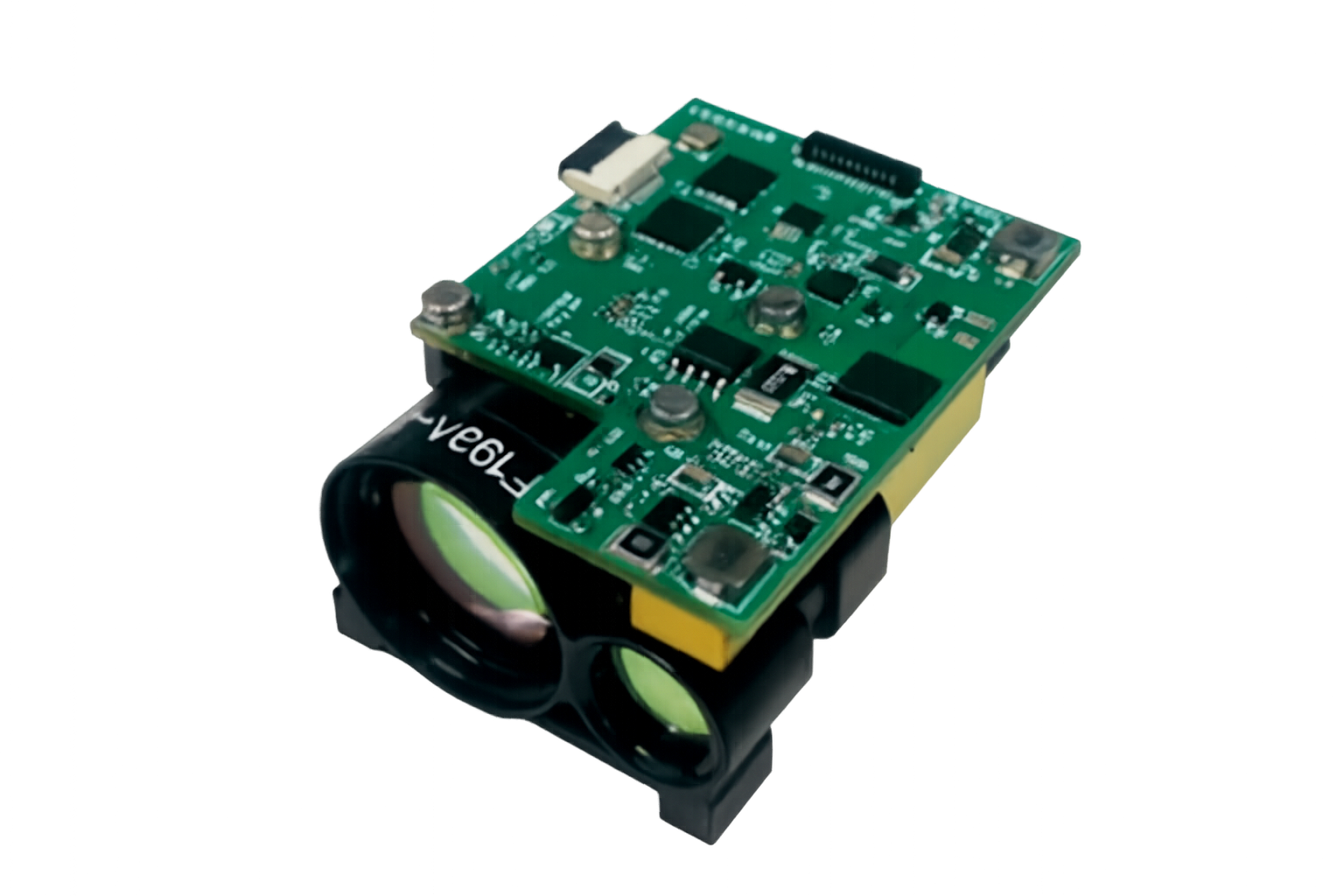
Size, Weight, and Power dictate drone payload lifespans. You want maximum target distance with minimum draw on the main battery bus, packed into a metal footprint no bigger than a matchbox.
Compact 1535nm Erbium Glass Laser Module: Pure Glass Muscle
Modern erbium glass modules bypass mechanical Q-switches and flashlamps entirely. Passive optical switches dump gigawatt bursts from tiny packages weighing under sixty grams. The assembly bolts straight onto your optical bench. No wasted wire bundles. Zero excess parasitic mass.
Heat Management Inside Sealed Spheres
Airborne turrets are sealed against rain and dust storms. Internal heat stays trapped. Antique flashlamp systems cook their own boards within minutes of continuous pulsing. Diode-pumped solid-state Er:glass hardware pulls tiny idle power, throwing pulses without turning your sealed gimbal into a miniature oven.
How We Build Solutions at CSOPT Limited
Standard catalog items rarely slot straight into custom gimbal shells. At CSOPT Limited, we manufacture dedicated 1535 nm laser rangefinder modules with measured operational reaches running from 3 km up to 20 km. We know the pain of shaving two millimeters off a chassis corner to clear a brushless motor winding.
Custom Optical Stacks for Tight Mechanical Envelopes
We avoid rigid off-the-shelf limits. Need RS-422 instead of standard TTL signals? Need wide-range input voltage to connect straight to a dirty aircraft power rail? We customize mounting patterns, alter optical collimators to adjust divergence, and adjust firing rates to match target requirements. You get drop-in optronics without redesigning your entire gimbal structure.
The Operational Verdict for Payload Integrators
Sticking with 905 nm diodes limits your detection reach and blinds your drone in humid air. Falling back on old 1064 nm crystals creates serious eye hazards and heavy thermal loads inside small shells. Choosing a 1535 nm core gives your sensor turret the exact balance required for demanding flight profiles: true multi-kilometer target locks, genuine eye safety, zero camera interference, and low mass that keeps airframes flying longer.
FAQ
Why is 1535 nm considered eye-safe compared to 1064 nm?
The human eye focuses light between 400 nm and 1400 nm directly onto the retina, multiplying optical density over 100,000 times. Light at 1535 nm gets absorbed by the cornea and front lens fluid before reaching the retina, allowing thousands of times higher pulse energy under Class 1 safety rules.
Can a 905 nm laser achieve a 10 km ranging distance?
No. Commercial 905 nm diodes lack the required peak pulse power and have wide beam divergence. Pulling clean photon returns from low-reflectivity targets at ten kilometers would burn out the semiconductor junction and exceed safe radiation limits.
What does SWaP mean in gimbal design?
SWaP stands for Size, Weight, and Power. It defines the physical and electrical envelope limits engineers must respect when packaging optics, sensors, and computing boards inside airborne payloads.
Does 1535 nm interfere with standard daylight video cameras?
No. Silicon-based CMOS and CCD image sensors cut off sensitivity past 1100 nm. The 1535 nm signal stays invisible to visible cameras, preventing optical washout during active ranging operations.
What custom options does CSOPT Limited offer for rangefinder modules?
CSOPT Limited delivers custom serial protocols (TTL, RS-422), altered supply voltages, tailored mechanical brackets, variable pulse repetition rates, and optimized collimation optics across ranges from 3 km to 20 km.