
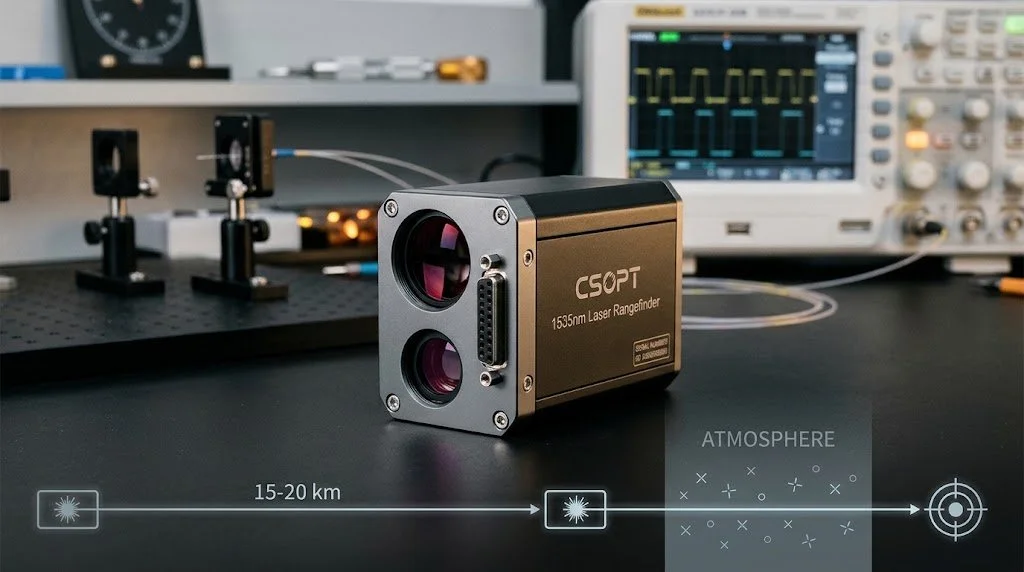
Shooting a laser beam across a sports field is straightforward: the atmosphere barely leaves a mark. Stretch that line of sight to 15 or 20 kilometers across open sea, hot plains, or desert borders, and air stops behaving like clean glass. It turns into a turbulent, living optical filter.
When an electro-optical payload aims for a target 20 kilometers out, the light pulse must travel a 40-kilometer round trip. Over that distance, moisture, airborne dust, heat shimmers, and ambient gas molecules actively absorb, deflect, and scatter photons. Hitting and reading targets consistently at this scale requires more than raw output power. It demands matching emitter optics to transparent spectral windows, balancing peak energy with eye-safety standards, and engineering optoelectronic assemblies that withstand extreme field conditions.
The Physics of Long Air Paths
Across extreme distances, energy decay follows the classical Beer-Lambert relationship. The primary metric governing signal reduction is the atmospheric extinction coefficient, which reflects two physical mechanisms: absorption and scattering.
Molecular gases—principally water vapor and carbon dioxide—absorb specific light bands, transforming radiant energy into heat. Solid and liquid aerosols—salt spray, pollen, sand grains, and water droplets—scatter light away from the optical path.
Because range finding depends on catching an echo, the signal pays this attenuation penalty twice:
Forward Leg: The emitted beam spreads out as it travels outward, shedding photons along the entire distance to the target.
Reverse Leg: Diffuse reflections from the target spread outward across a broad angle, losing another heavy layer of energy on the return flight to the receiver aperture.
Even slight shifts in airborne particulates can cause received signal power to fluctuate by multiple orders of magnitude over a 30-to-40-kilometer journey.
Why 1535 nm Outperforms Legacy Wavelengths
Early rangefinders relied heavily on 905 nm diode lasers or 1064 nm Nd:YAG crystals. Both struggle when pushed into the 10-to-20-kilometer envelope. The short-wave infrared (SWIR) 1535 nm band offers distinct operational advantages over these legacy options.
1. Low Atmospheric Absorption
The 1.5-micron region sits squarely in a natural transmission corridor. It avoids major water vapor absorption lines, giving it a much lower extinction rate than neighboring bands.
2. High Eye-Safe Peak Energy
Wavelengths below 1.4 microns penetrate the cornea and lens, concentrating intense energy directly onto the human retina. To prevent permanent retinal damage, safety regulations keep power outputs for 905 nm and 1064 nm units strictly capped.
At 1535 nm, fluid in the front of the eye absorbs incoming energy before it can strike the retina. This allows 1535 nm Erbium-glass (Er:glass) emitters to fire high-energy megawatt pulses while staying fully Class 1 eye-safe. This reserve energy helps the beam punch through thick maritime haze and dust layers without creating hazards for friendly forces or nearby civilians.
3. Solar Noise Rejection
Midday sunlight drenches the earth in visible and near-infrared rays, easily overwhelming sensitive receiver photodiodes. Solar irradiance falls off sharply around 1535 nm. Equipping an Indium Gallium Arsenide (InGaAs) photodiode with a narrow bandpass filter lets the sensor filter out ambient daylight, keeping signal-to-noise ratios high on clear, sunlit afternoons.
Penetrating Fog, Precipitation, and Particulates
Atmospheric water and airborne dust disrupt optical beams differently based on their particulate size relative to the laser wavelength.
Fog Dynamics and Range-Gating
Fog consists of suspended water droplets. Radiative valley fogs carry small droplet diameters (2 to 8 µm), while coastal advection fogs carry larger droplets (10 to 20 µm). Both trigger intense Mie scattering. In dense fogs where visibility drops below 2 kilometers, optical losses can easily exceed dozens of decibels per kilometer, blunting standard distance checks.
Near-field backscatter presents another hurdle. Droplets near the emitter reflect light straight back into the receiver lens, dazzling the photodetector like high beams in a blizzard.
Modern long-range modules resolve this through electronic range-gating. The receiver ignores all signals for the first few microseconds after firing, letting the pulse clear close-range moisture before the sensor turns on. Reflections from rain, spray, or smoke within the first 500 to 1,500 meters are ignored, preserving detector sensitivity for the actual target echo.
Haze and Airborne Desert Dust
Haze particles (sub-micron pollutants and fine aerosols) scatter shorter wavelengths rapidly. At 1535 nm, these sub-micron particles scatter light far less than visible or 905 nm beams, helping the sensor maintain targeting locks even when horizons appear milky to the naked eye.
Blowing dust and desert sandstorms create tougher challenges. Irregular sand grains measuring 20 to 100 µm cause severe signal scattering and pulse broadening: a crisp 5-nanosecond outgoing pulse can return as a smeared 20-nanosecond echo.
Dust also settles on target surfaces, lowering their optical reflectivity. Pulling faint, stretched echoes out of background noise requires high-sensitivity InGaAs Avalanche Photodiodes (APDs) paired with digital signal processors that can isolate weak returns using multi-pulse statistical algorithms.
Thermal Stabilization: Protecting System Alignment
Field operations subject sensor payloads to harsh temperature swings, from freezing high-altitude flights (-40°C) to baking desert vehicles (+65°C). Uncompensated electro-optics will degrade quickly in these conditions.
As temperatures rise, solid-state Er:glass cavities expand, subtly shifting mirror alignments and reducing peak pulse energy. High-grade assemblies use low-expansion alloys like Invar to maintain optical alignment across the entire thermal envelope.
The receiver side faces similar thermal pressures. An APD's avalanche multiplication gain shifts with ambient temperature. Left unmanaged, cold weather can send receiver gain skyrocketing into self-oscillation, while summer heat will depress gain and elevate dark-current noise. Built-in temperature-sensing circuits continuously adjust the APD’s reverse bias voltage, stabilizing amplification from icy mornings to mid-afternoon heatwaves.
Custom 1535 nm Engineering with CSOPT Limited
Integrating long-range rangefinders into specialized electro-optical pods, multi-sensor gimbals, or tactical equipment leaves little room for generic, off-the-shelf assemblies. Payloads demand precise mechanical layouts, tight weight allocations, and custom interface programming.
CSOPT Limited develops and manufactures OEM 1535 nm Laser Rangefinder Modules designed for tough operational environments. With complete production lines, cleanroom test facilities, and dedicated optical engineering teams, CSOPT provides customized sensor cores for demanding integration projects.
Core Capabilities
Range Coverage: High-efficiency modules rated from compact 3 km platforms up to 20 km ultra-long distance observation payloads.
Narrow Beam Profiles: Precision optical collimators offering tight beam divergence (down to 0.3 mrad) to concentrate energy on small, low-contrast targets.
Environmental Sealing: Hermetically sealed, dry-nitrogen-purged enclosures with Diamond-Like Carbon (DLC) window treatments for salt-spray and abrasion protection.
Electronics and Integration: Native support for RS-422, RS-232, and TTL communications, with variable pulse rates (single shot, 1 Hz, 5 Hz, 10 Hz) and multi-target firmware settings.
Whether retrofitting maritime surveillance towers, configuring border patrol gimbals, or reducing weight for drone-mounted systems, CSOPT engineers modules that meet exact volume, optical, and communication needs.
Frequently Asked Questions
Why does 1535 nm perform better than 905 nm beyond 10 kilometers?
The 905 nm band is constrained by Class 1 eye-safety standards because light passes straight through to the retina, forcing manufacturers to cap pulse energy at low levels. The 1535 nm wavelength is naturally absorbed in the outer eye before reaching retinal tissue. This lets 1535 nm emitters deliver substantially higher peak pulse energy while remaining eye-safe, giving pulses the power to overcome atmospheric attenuation across long distances.
How does electronic range-gating help in bad weather?
Close-range moisture and dust reflect light back into the receiver, blinding the sensor. Range-gating keeps the photodiode circuit inactive for the first few microseconds after a pulse is fired, ignoring close-in clutter from the first 500 to 1,500 meters and ensuring the detector stays ready for genuine echoes from distant targets.
What causes range accuracy to drift in extreme heat?
High temperatures cause mechanical expansion inside laser cavities, altering optical path lengths and reducing pump-diode efficiency. At the same time, receiver APDs experience shifts in breakdown voltage and higher thermal noise. High-grade systems stabilize performance by pairing low-expansion mechanical mounts with active, temperature-dependent bias adjustments on the photodiode.
Can an uncooled 1535 nm rangefinder acquire a target at 20 km in high humidity?
Yes, provided the target has adequate surface area, sufficient reflectivity, and general visibility remains clear. While 1535 nm avoids primary water-vapor absorption lines, high humidity paired with dense aerosols (wet haze or fog) will scatter photons and shorten operating range. Tight beam divergence and high peak power help maintain target lock.
What customizations does CSOPT Limited offer for third-party electro-optical systems?
CSOPT provides complete OEM customization, including tailored physical enclosures, custom mounting configurations, optical collimator tuning for narrow divergence, adjustable pulse repetition rates (1 to 10 Hz), hardware communication interfaces (RS-422, TTL), and hardened window coatings.